Spined Mason Bee
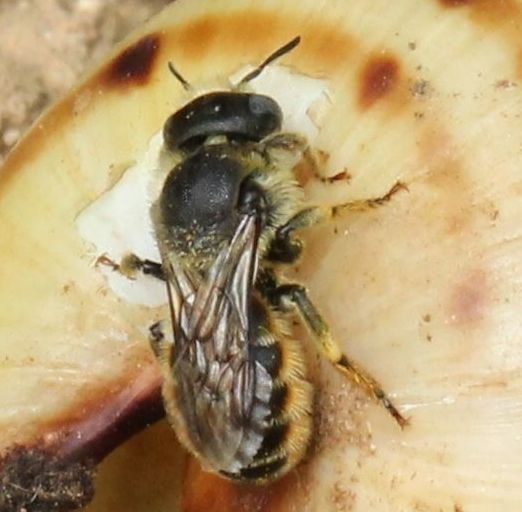
Spined Mason Bee - Osmia spinulosa
The taxonomy of Osmia spinulosa has been the subject of considerable debate. Recent genetic work carried out in Switzerland by Mueller, shows that this taxon should correctly be placed within the genus Osmia rather than left within Hoplitis.

Records should include a photo, or set of photos, showing the key characters. We will accept records identified by a recognised local or national expert, or that have been identified via the BWARS’ Facebook group noting the name of the person/organisation identifying the record (e.g. ‘Stuart Roberts, BWARS Facebook’).
It is found in a range of open neutral or calcareous grassland habitats, provided that there are plenty of Asteraceae flowering and a degree of litter build-up around tussocks. This is where the snails, whose shells provide the nest site, live out their lives. Hay-cut and hard-grazed grasslands are not suitable for this bee.
From mid May to late September.
Nests are made within medium sized old snail shells, such as those of Cepea nemoralis. The cells are made within the spiral from chewed plant material.
Widespread mainly south of a line from The Wash through to South Wales, although not always frequently found even in these areas.
Rare or under recorded in Leicestershire and Rutland. The record from Ketton Quarry on 19th Aug 2015 is believed to be the first for VC55.
 Steve Woodward
Ketton Quarry
19 August 2015 Steve Woodward
Ketton Quarry
19 August 2015

Leicestershire & Rutland Map
Enter a town or village to see local records
MAP KEY:
Yellow squares = NBN records (all known data)
Coloured squares = NatureSpot records: 2025+ | 2020-2024 | pre-2020
UK Map
Additional images
No additional images available for this species.