Spear-leaved Orache
Spear-leaved Orache - Atriplex prostrata
Spreading, prostrate to erect, medium tall plant. Green mealy when young often reddening with age. Leaves arrow shaped generally not mealy, with the basal lobes at right angles to the stalks. Flowers in fairly dense panicles, leafy below. Fruits enclosed in triangular toothed bracts.
Atriplex patula. Other aliens species may occur, and if in doubt, the key in Stace (4th edn.) should be referred to.
Goosefoots (Chenopodium) are quite similar, and young plants can be difficult to determine.
All Atriplex have the fruits enclosed by two enlarged bracteoles.

Lower leaves triangular or spear-shaped. Bracteoles fused at base only, for less than a quarter of the way.
Photos must show ripe fruits enclosed in bracteoles, and lower leaves
Arable land, waste places, disturbed ground, coastal habitats and shingle. Often by roadsides, in the salt-splash zone
July to October.
Annual.
Quite common in England south of the Humber, coastal elsewhere.
Fairly frequent in Leicestershire and Rutland. In the 1979 Flora survey of Leicestershire it was found in 238 of the 617 tetrads.
 Ramsdale Farm Sapcote SP 4969 9253 (taken 9.8.2006).JPG) Graham Calow
Graham Calow
Sapcote
09 August 2006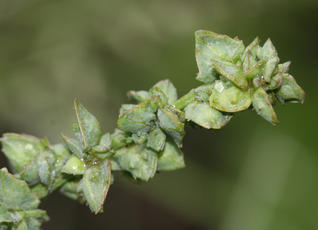 David Nicholls
Cossington
11 October 2011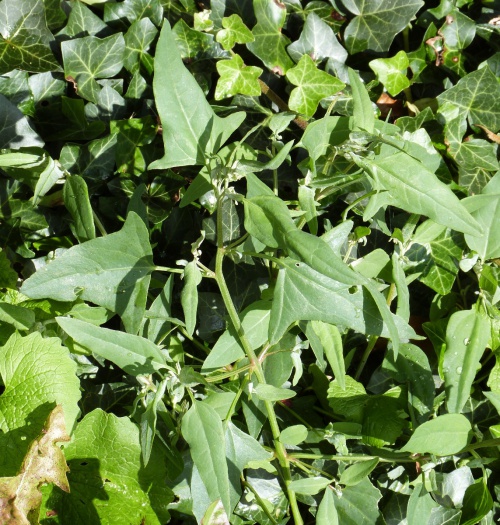 Graham Calow
Cambridge Road, Cosby
08 July 2016 David Gould
Aylestone Meadows
15 August 2014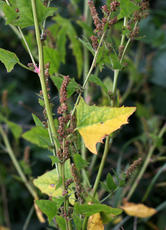 David Nicholls
Cossington
11 October 2011 Old Fosse Sapcote SP 4994 9233 (taken 20.8.2007).JPG) Graham Calow
Graham Calow
Sapcote
20 August 2007
 Ramsdale Farm Sapcote SP 4969 9253 (taken 9.8.2006).JPG)


 Old Fosse Sapcote SP 4994 9233 (taken 20.8.2007).JPG)
Leicestershire & Rutland Map
Enter a town or village to see local records
MAP KEY:
Yellow squares = NBN records (all known data)
Coloured squares = NatureSpot records: 2025+ | 2020-2024 | pre-2020
UK Map
Additional images
No additional images available for this species.
All NatureSpot records
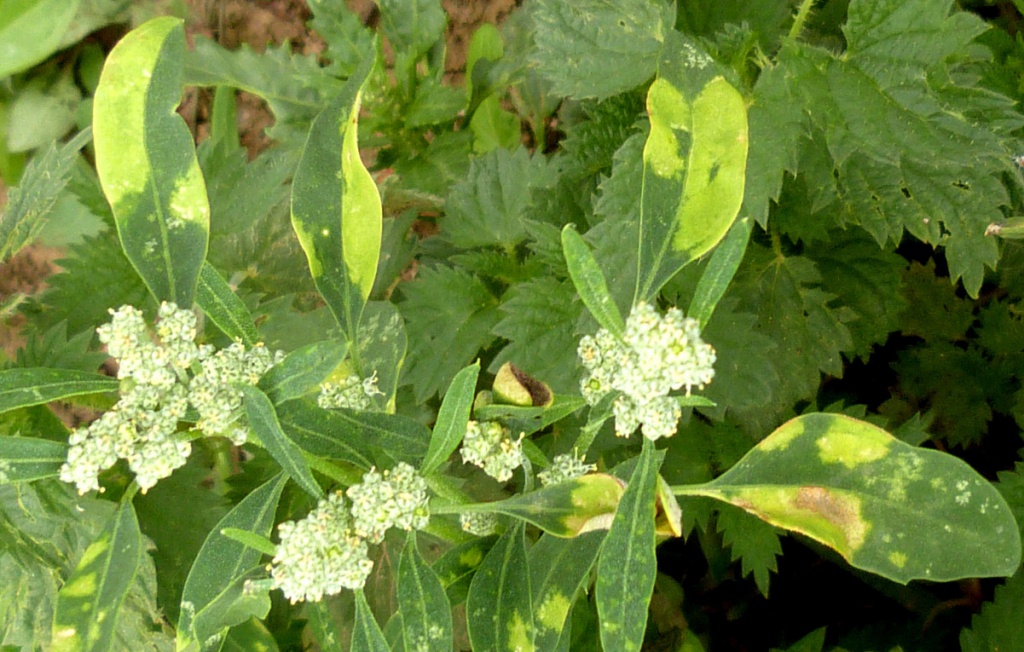
Peronospora farinosa s. lat.
Peronospora farinosa can cause yellowish swellings on the leaf blade of the host plants in the family Amaranthaceae, such as Fat-hen and Oraches, often affecting several leaves of the same plant. The affected leaves can become swollen and slightly distorted. This downy mildew can also have a purplish tinge.