Red-breasted Merganser
Red-breasted Merganser - Mergus serrator
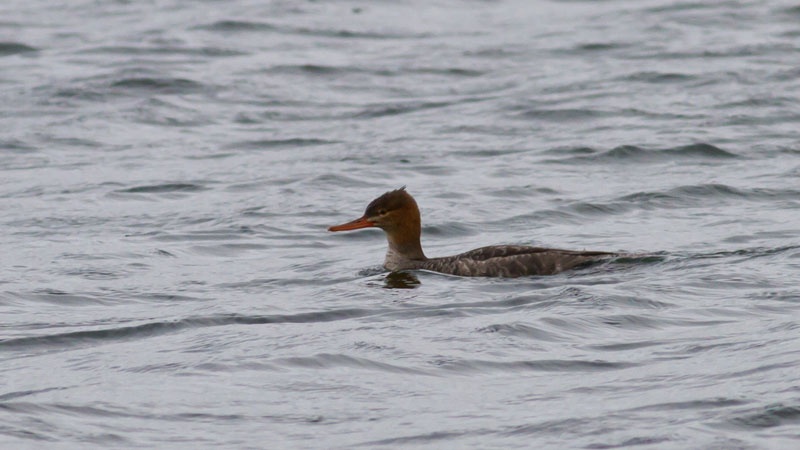
A diving duck belong to the sawbill family, so called because of their long, serrated bills, used for catching fish. Mergansers in all plumages are characterised by their scruffy appearance. Even the male with his reddish breast band and green glossed head contrives to look bedraggled. Mergansers and Goosanders in the duller brown plumages of females and immatures are known as red-heads. In a Merganser the red on the head merges gradually into the mucky-grey on the neck and body whereas the Goosander shows clear demarcation. The shaggy crest and upswept bill add to their eccentrically untidy appearance. In flight they also look skinny and straggly. The males are almost entirely white on the inner wing whereas the females have only a white panel around the secondaries. In Mergansers this panel is broken by a complete dark horizontal line.
Whilst the male Red-breasted Merganser is easily distinguished from the male Goosander, the females of both species are very similar as discussed above

At home on both fresh- and saltwater, they are most commonly seen around our coastline in winter. They are gregarious, forming flocks of several hundred in the autumn. Small groups are regularly seen during the winter months on inland reservoirs. The UK breeding population is concentrated in the north-west of Scotland, England and Wales, and in parts of N. Ireland.
UK birds start to flock on the coast from July, reaching a peak in December. Birds from N Europe also arrive in late autumn. They return to the breeding areas in March
2,000+ breeding pairs with 8,500 individuals over-wintering
Scarce winter and passage visitor, mainly from October to February
 Rod Baker
Rutland Water
08 November 2012
Leicestershire & Rutland Map
Enter a town or village to see local records
MAP KEY:
Yellow squares = NBN records (all known data)
Coloured squares = NatureSpot records: 2025+ | 2020-2024 | pre-2020
UK Map
Additional images
No additional images available for this species.