Lace-weaver Spider
Lace-weaver Spider - Amaurobius similis
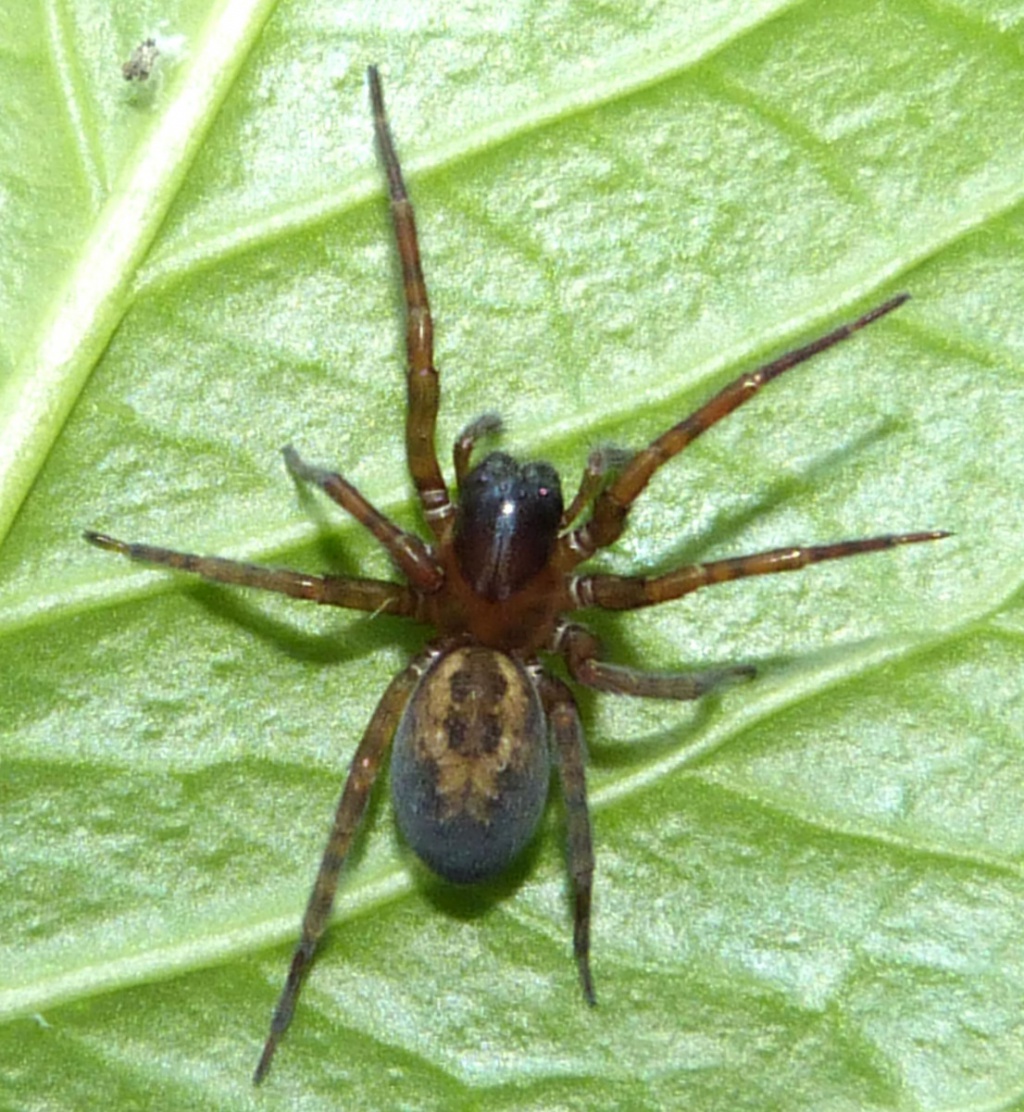
Female to 12 mm; male to 8 mm. Distinctive, with a glossy brown carapace and legs and a velvety abdomen with a dark anterior wedge-shaped marking surrounded by cream. It often lives around buildings where it occupies holes in walls, fences, window frames, etc.
This species is very similar to A. fenestralis and the two cannot reliably be distinguished by eye. If in a garden or associated with houses then it is more likely to be A. similis, however if in woodland it more likely to be A. fenestralis. However, habitats overlap so this species: "Requires examination at high magnification in good lighting, typically examination of the genitalia." Bee, L., Oxford, G., & Smith, H. (2020). Britain's Spiders: A Field Guide. Second Edition. Princeton University Press.

Requires examination at high magnification in good lighting, typically examination of the genitalia.
Frequently seen around houses and gardens. These spiders produce a bluish coloured silk around the entrance to holes and crevices on just about every wall you look at.
Adult females all year; males from June to November.
Widespread and frequent in Britain
Common in Leicestershire and Rutland.
3,759 British records for this species to 2015.
 Graham Calow
Sapcote
29 March 2014
female - specimen examined Graham Calow
Sapcote garden1
29 March 2014
male - specimen examined Graham Calow
Sapcote
30 April 2013
female - specimen examined Graham Calow
Sapcote garden1
17 February 2014
female - specimen examined David Nicholls
Ratby garden1
13 September 2006 David Nicholls
Ratby garden1
13 September 2006


Leicestershire & Rutland Map
Enter a town or village to see local records
MAP KEY:
Yellow squares = NBN records (all known data)
Coloured squares = NatureSpot records: 2025+ | 2020-2024 | pre-2020
UK Map
Additional images


