Corn Bunting
Corn Bunting - Emberiza calandra
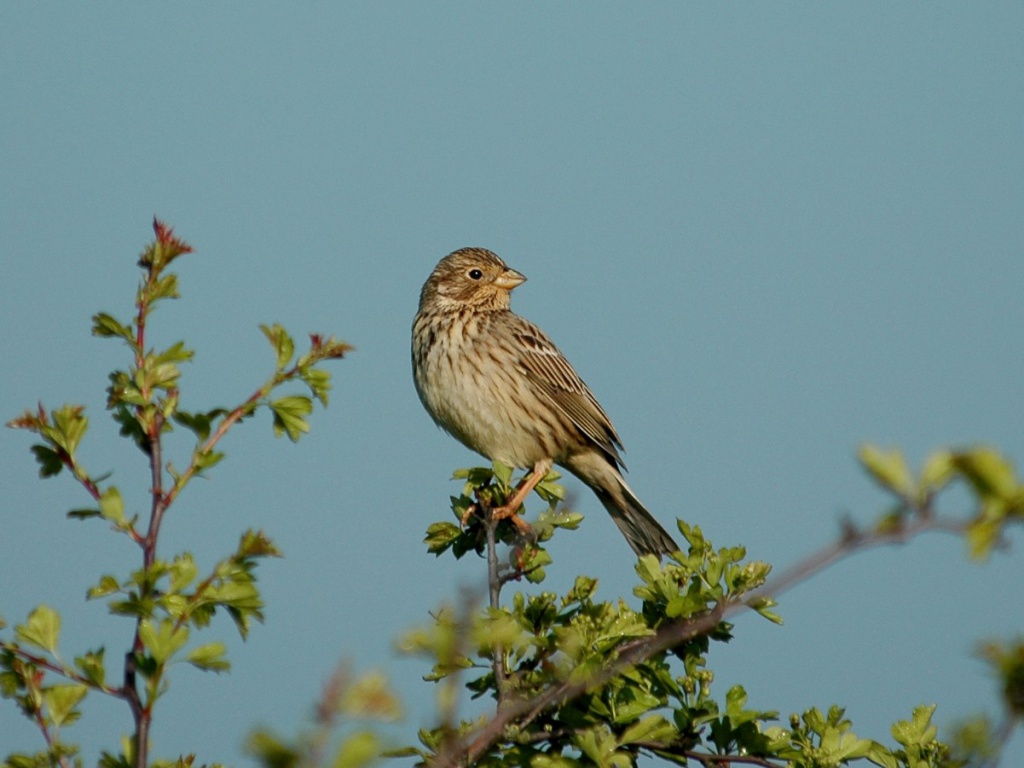
The largest and least distinctive bunting; always appears bulky with large head and proportionately short tail. Grey-brown above and whitish below, streaked darker all over. The streaks often converge to form a dark spot in the centre of the breast. Differs from similar buntings by lack of white in outer tail feathers. The face pattern is plain and shows no notable features except a blackish malar stripe and a large pale bill. The legs are quite pale, flesh brown to straw-yellow. Can be heard singing from early spring until early autumn. Sings from an elevated position and often sings in flight with legs trailing. Song often likened to a bunch of jangling keys.

The Corn Bunting is a bird of farmland and grassy areas.
It can be seen at any time of the year.
The breeding season varies a great deal according to local conditions and some males are monogamous whilst others are polygamous. The nest is usually placed on the ground in grass or herbage, but sometimes in low bushes or trees.
Corn Buntings have undergone severe breeding population decline by as much as 90% between 1970 and 2010 and as such the population has become fragmented. The summer and winter distribution is similar.
Like the rest of the UK, the species has declined alarmingly within Leicestershire and Rutland and there now appears to be only a small population in the north west, which is probably also in decline.
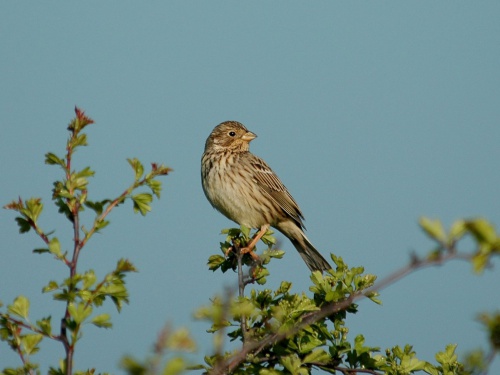 David Taylor
Orton on the Hill
29 April 2009
Leicestershire & Rutland Map
Enter a town or village to see local records
MAP KEY:
Yellow squares = NBN records (all known data)
Coloured squares = NatureSpot records: 2025+ | 2020-2024 | pre-2020
UK Map
Additional images
No additional images available for this species.