Papillose Bog-moss
Papillose Bog-moss - Sphagnum papillosum
Sphagnum papillosum forms mats and low hummocks, developing warm orange/ochre tints in unshaded places. In shade it can be green. Usually, spreading branches are short and there are only one or two pendant branches.
It is in Section Sphagnum, characterised by hooded concave branch-leaves and a wide, pale outer cortex to the stem, which has a dark core. The stem cortex is made up of 3-4 rows of hyaline (clear and transparent) cells.
Sphagnum palustre is similar but lacks the papillae on the cell walls which are only visible under high magnification; it also typically has up to 4 pendant branches.

Detailed photographs taken in the field and from a specimen. We recommend that a detailed note of location or GPS reading is made and that a small specimen - e.g. two or three shoots - is retained in case this is needed for verification; all Sphagnum are rare or scarce in VC55 and should not be over-collected.
Typically found on raised and blanket bogs, in valley mires and beside flushes.
All year round.
Widespread and fairly frequent in much of Britain, but less common in central and eastern England. A peat-forming moss indicative of good quality habitat
Rare in Leicestershire and Rutland (only recorded from Charnwood Lodge).
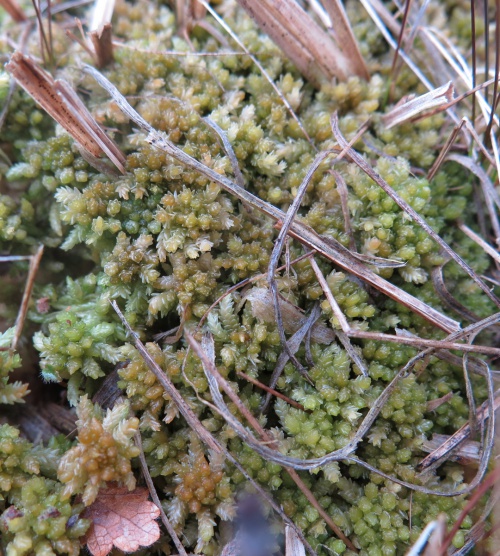 David Nicholls
Charnwood Lodge
28 March 2015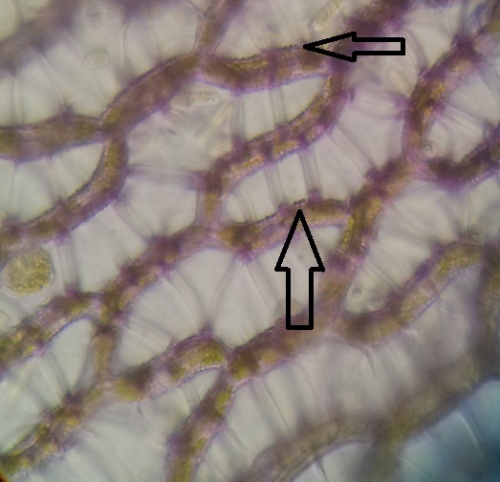 Uta Hamzaoui
Charnwood Lodge
28 March 2015
papillose cell walls
Leicestershire & Rutland Map
Enter a town or village to see local records
MAP KEY:
Yellow squares = NBN records (all known data)
Coloured squares = NatureSpot records: 2025+ | 2020-2024 | pre-2020
UK Map
Additional images
No additional images available for this species.