Borage
Borage - Borago officinalis
Bristly plant about 50 cm in height. Flowers bright blue with a whitish centre, 20 to 25 mm half nodding and rather star shaped, with spreading pointed lobes and a prominent cone of purple black stamens, borne in broad branched cymes.

Gardens, cultivated land, waste ground and waysides.
May to September.
Annual, occasionally overwintering. Most records are probably casuals or garden escapes.
Widespread, particularly in England but often casual and rarely plentiful.
Uncommon in Leicestershire and Rutland. Borage was not recorded the 1979 Flora survey of Leicestershire.
 self seeded at 22 Pougher Close Sapcote SP 4898 9304 (taken 30.8.2006).JPG) Graham Calow
Graham Calow
Sapcote
30 August 2006
self seeded Graham Calow
Sapcote, Stanton Road
24 April 2023
White Borage - Borago officinalis 'Alba' Graham Calow
Sapcote, Stanton Road
24 April 2023
White Borage - Borago officinalis 'Alba' Graham Calow
Fosse Meadows, Sharnford
27 August 2014 Alan Semper
Stathern, path
01 May 2015 Barbara Cooper
Long Clawson, The Sands
02 September 2013
growing in footpath Graham Calow
Stoney Stanton
23 June 2016 Graham Calow
Sapcote, Field off Pougher Close
03 October 2019 martindgrimes
Wardley Wood
09 April 2017
 self seeded at 22 Pougher Close Sapcote SP 4898 9304 (taken 30.8.2006).JPG)


Leicestershire & Rutland Map
Enter a town or village to see local records
MAP KEY:
Yellow squares = NBN records (all known data)
Coloured squares = NatureSpot records: 2025+ | 2020-2024 | pre-2020
UK Map
Additional images


All NatureSpot records
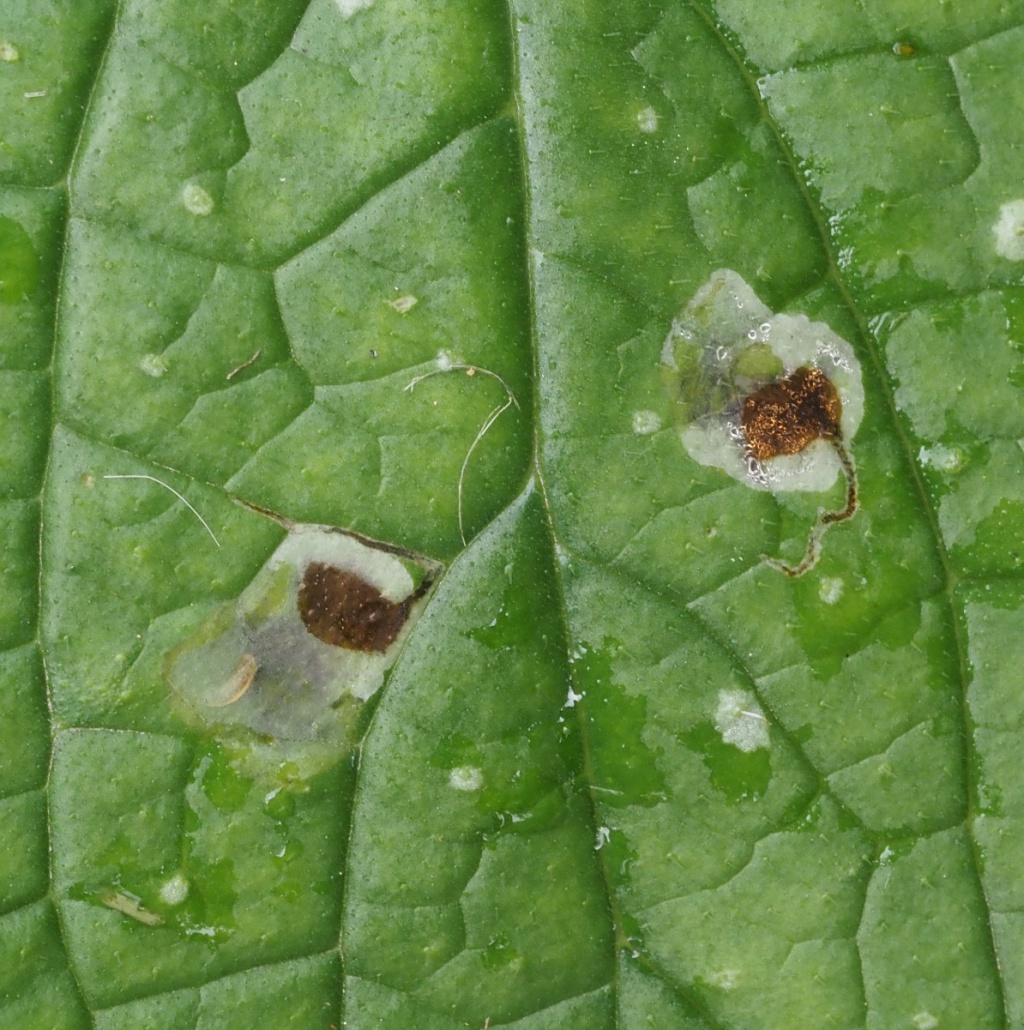
Agromyza abiens/myosotidis/lithospermi agg.
The larvae of the Agromyzid flies Agromyza abiens, Agromyza myosotidis and Agromyza lithospermi produce identical mines on the leaves of several food plants in the Boraginaeceae family, such as Borage, Comfrey and Green Alkanet plus a number of other host plants. The initial narrow gallery contains frass in a double line, which it then expands to form a blotch mine. Several larvae may occupy a leaf to form a large blotch. Because the mines on these plants cannot be reliably separated to species level we treat them as an aggregate.